
Who's Afraid of Books?: Reading as Resistance
by Grace Grocholski
“The function of literature is to ask questions we don’t know the answers to; to have the wild and wonderful horrible world laid bare before us; to see ourselves, to see each other; and to broaden our minds past the confines of the geography we were born to. Literature is freedom.” —Maggie Tokuda-Hall
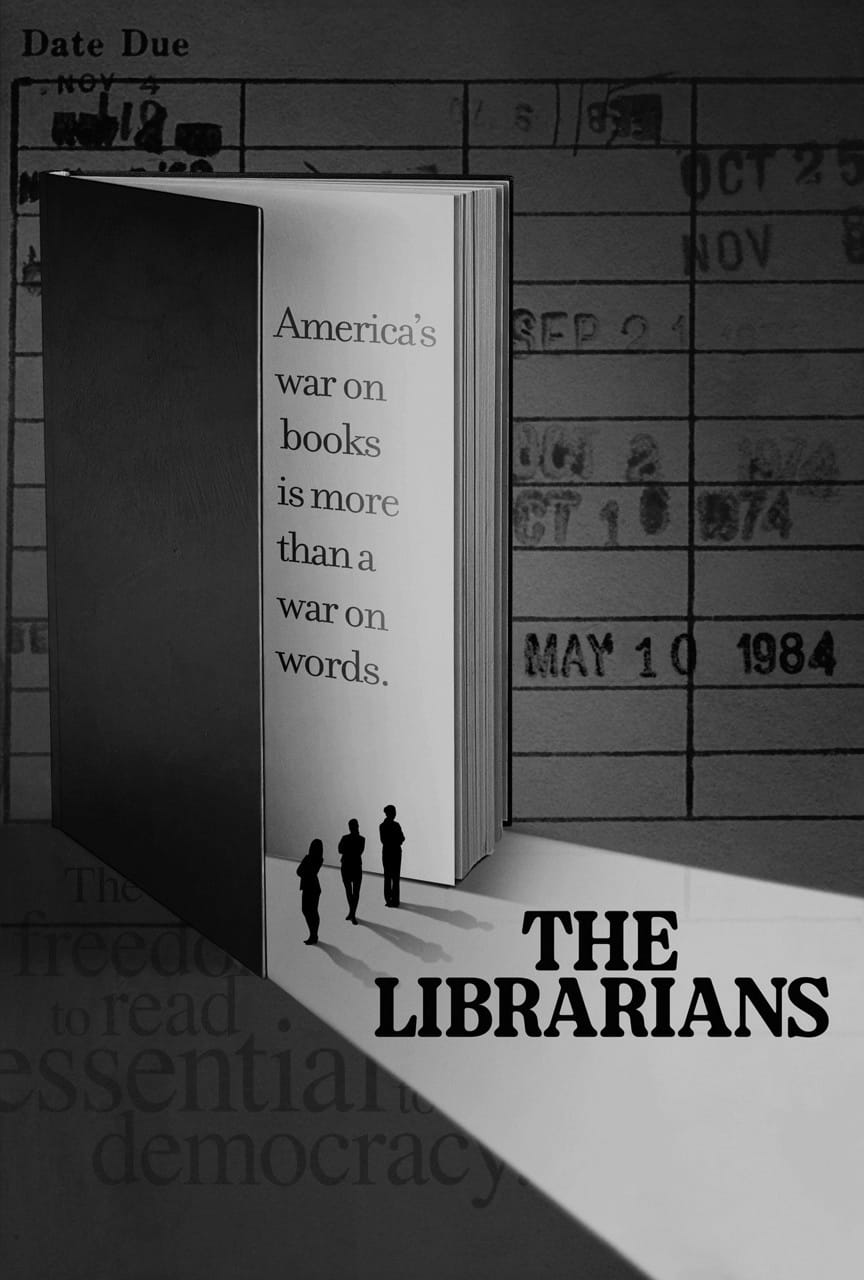
The opening sequence in Kim A. Snyder‘s gripping and timely 2025 documentary, The Librarians, highlights Ray Bradbury‘s infamous opening lines of Fahrenheit 451: “It was a pleasure to burn. It was a special pleasure to see things eaten, to see things blackened and changed.” Bradbury’s 1953 novel of course takes place in a dystopian timeline in which firemen are tasked with burning books, rather than putting out fires, and people, who are forbidden to read, content themselves with mindless entertainment. The line has a chilling effect when taken in context with the explosion in the past five years of book challenges and book bans in public schools nationwide. According to PEN America (a non-profit organization that works to protect global free expression), 3,743 unique book bans took place across the US in 2024-2025. PEN America details the culture in which this is permitted:
“For books banned in the 2024-2025 school year, a strain of anti-intellectualism, as illustrated in bans on nonfiction titles, also mirrors the broader political attack on facts and knowledge and the skepticism and devaluation of, and disdain for, experts and expertise—tactics long associated with the rise of authoritarian regimes and intended to sow distrust in democratic institutions.”
Snyder’s documentary follows the school librarians caught in the crossfire of intellectual freedom and state censorship. Often co-ordinated by outside political groups, as the documentary shows with the presence of Moms for Liberty, school boards challenge books discussing sexuality, race, and gender, ultimately compiling lists of books to be banned. Librarians, whose role is to help students find access to resources, and whose ethical code explicitly states they must not exclude books based on differing viewpoints, find themselves compelled to remove texts that are deemed harmful or threatening.
Why are these texts so divisive? How have ideas and access to information come to be seen as something to fear? The answer lies in how modern political movements weaponize identity; a phenomenon philosopher Judith Butler dissects in Who’s Afraid of Gender?
Butler posits that political groups, particularly authoritarian and fascist regimes, consolidate power by denouncing “social movements, including feminism, multiculturalism, and LGBTQIA+ rights and freedoms, against civil rights and the protection of the rights of migrants and refugees”. This is done, Butler explains, “because these entities threaten the stability and purity of the nation.”
Once a seemingly benign concept, Butler explores how gender has become an alleged danger, not just in the US but worldwide, threatening patriarchal power and existing social structures. As an academic concept, gender can refer to a sociological or cultural construct, where “continuing debates about the word show that no one approach to defining, or understanding, gender reigns”. But in terms of the anti-gender ideology movement, gender becomes a “monolith, frightening in its power and reach”.
In clear, precise prose Butler breaks down why this view of gender as an alarming “ideology” is incorrect and how it has become a fearsome “phantasm”. The implications of framing gender as an enemy are destructive. What is actually threatened are reproductive rights, the rights of women, the rights of queer people, the rights of trans and non-binary people, and all efforts to achieve equality and justice.
Who’s Afraid of Gender? explores the harm done when gender becomes an ideology to oppose in the minds of no legislative bodies who mandate what can and cannot be taught. Which brings it back to the books. In Chapter 3, Butler asks, “Is the assumption that if children read about something, they will become that thing? What strange powers are attributed to reading and to books?”
Snyder‘s film shows that those who want books removed are operating under the erroneous assumption that mentions of gender and sex, or books with characters who are not white men or women, are harmful “pornography”. Under the guise of concern for the children, they seek to remove access to stories, characters and factual information, to stamp out ideas, and to curtail intellectual freedom and curiosity. The bans are public displays of authoritarian power. Butler continues: “is it that teachers…are “recruiting” the youth into “woke” and gender ideology, or is it the plethora of bans and legislative efforts against feminism, race studies, and LGBTQIA+ topics that constitutes an instrument of recruitment for the Right?”
Butler and Snyder both make clear that book bans are a tool for authoritarian consolidation of power. When books and the librarians who organize them are seen as the villains, there is a fundamental issue with the story being told.
As concerning as Snyder’s documentary is, it gives me hope for librarians across the country who are fighting against censorship, and for intellectual freedom. Librarians like Carolyn Foote, Suzette Baker, and Amanda Jones, who risk their professional and personal lives in service of a greater good. The fact that I was able to borrow both the documentary and Butler’s book from the public library gives me hope. I am galvanized each day I work at the library, helping a child or an adult find a book that they are excited to read. We should be expanding minds, not limiting them. Books fill our minds with ideas, with curiosity and compassion. As author Maggie Tokuda-Hall noted, literature is freedom. In a political climate that seeks to undermine knowledge and education, reading them is more urgent than ever.
Works Cited
Bradbury, Ray. Fahrenheit 451. Ballantine Books, 1953.
Butler, Judith. Who’s Afraid of Gender? Farrar, Straus and Giroux, 2024.
PEN America. “The Normalization of Book Banning: Banned in the USA 2024-2025”. PEN America, 2025, pen.org. “Facts & Fiction: Stories Stripped Away By Book Bans” PEN America, 2026, pen.org
Snyder, Kim A., director. The Librarians. Red Pebble Films / Artemis Rising Foundation, 2025.
Tokuda-Hall, Maggie. “The function of literature is to ask questions...” Twitter / X, 2023.
Grace Grocholski is a part-time librarian, full-time bookworm. In her spare time, she enjoys running, baking, and feeding her online chess addiction. Along with being a regular contributor in fsm., you can read her writings on Substack at https://substack.com/@groggygee